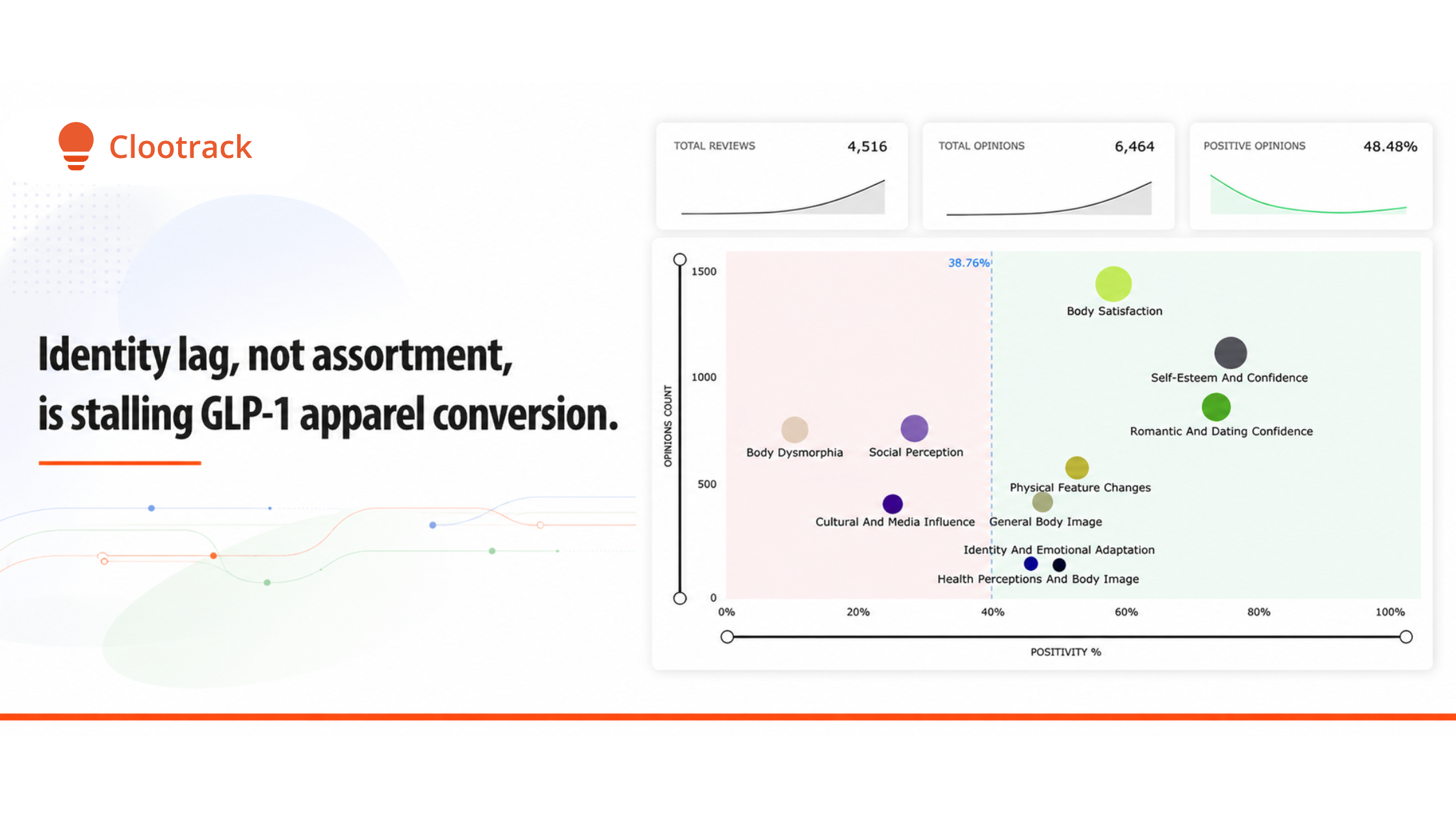
Apparel traffic from GLP-1 consumers is rising. Conversion is not. New VoC data from Clootrack shows that identity lag is the mechanism stalling baskets.
NEW YORK, NY, UNITED STATES, May 6, 2026 /EINPresswire.com/ — There is a specific kind of retail problem that does not appear in any dashboard: the customer who tries everything on and leaves empty-handed. Traffic metric: healthy. Conversion metric: soft. Standard diagnosis: assortment weakness or demand decline.
For the GLP-1 consumer, that diagnosis is wrong. The conversion stall is not a category signal. It is a psychological one, and it does not respond to the interventions retailers typically reach for.
Clootrack analyzed 95,854 GLP-1 consumer conversations using its Voice of Customer analytics platform. Clootrack was recognized by OpenAI last year for processing over 100 billion tokens in Voice of the Customer analytics.
What the data reveals is not a shift in what consumers want. It is a shift in whether they can yet trust that the change is real.
Body change happens faster than identity catches up
Weight loss is measurable. Identity adjustment is not.
Across 6,464 body image-related mentions in Clootrack’s dataset, positive sentiment sits at only 48.5%. Physical change has occurred. Compliments are arriving. Old clothes no longer fit. And yet the internal experience remains one of division, not confidence.
Body Dysmorphia conversations carry 11% positive sentiment with 74.4% month-over-month growth, confirming that negative body perception is accelerating faster than positive body confidence.
Consumer language captures the experience precisely:
“I’ve lost 60 pounds. I know this intellectually. But when I look in the mirror, I see the same person. The only time I believe it is when I try on pants and they’re too big. Then I cry in the fitting room.”
Fit Comfort conversations are up 71.1% month-over-month, not because shopping engagement is rising, but because consumers are using fitting rooms to confirm that their body has changed rather than to make purchase decisions.
A consumer seeking confirmation behaves completely differently from a consumer with purchase intent, and most retail environments are designed exclusively for the latter.
Three constraints are stalling the same purchase
The dataset reveals three psychological constraints operating at the same time.
– Size uncertainty: Weight loss is ongoing and consumers do not know when it will stabilize. Any purchase at the current size feels financially premature.
– Financial waste perception: Wardrobe Transition Cost conversations show 116.7% month-over-month growth at only 42.5% positive sentiment. Consumers are not hesitating because apparel is too expensive. They are hesitating because buying the right size today may mean the wrong size in two months.
– Identity lag: The psychological sense of self has not yet updated to match the body. Purchasing for a size the consumer does not internally recognize feels inauthentic. This constraint does not respond to price cuts. It resolves through time.
“I went shopping three times last month and bought nothing. I don’t know what size I am. I don’t know what fits. I just stood there and left.”
These three constraints compound. Price cuts do not resolve size uncertainty. Promotions do not close an identity gap. Inventory risk rises when conversion shortfall is treated as demand weakness rather than behavioral friction.
The hesitation window is temporary. The recovery signal is already visible.
Beneath the stall, a counter-signal is building with direct commercial implications for retailers positioned to capture it:
– Fashion Confidence: 98.6% positive sentiment, 218.9% month-over-month growth
– Style Evolution: 87.9% positive sentiment, 126.7% month-over-month growth
– Style Preference Changes: 79.2% positive sentiment, 114.8% month-over-month growth
As weight stabilizes, consumers move from functional replacement toward intentional self-expression. New Clothing Purchase conversations carry 74.2% positive sentiment. The desire is present. Purchase Frequency sits at 48.1% positive with 0% month-over-month growth. The transaction is waiting on a behavioral timeline, not a promotional one.
Retailers who reduce friction now (through exchange policies that remove financial risk, fit technology that addresses size uncertainty, and flexible sizing that lowers the commitment threshold) are better positioned to capture fashion confidence spend when it arrives. Retailers who discount through the stall are solving for price sensitivity in a consumer whose hesitation has nothing to do with price.
The complete analysis is available in Clootrack’s 2026 retail intelligence report: Full GLP-1 retail demand analysis.
Methodology
This analysis is based on 95,854 GLP-1-related consumer conversations collected between January 2022 and December 2025, with 340,725 opinions extracted across forums, social media, and health review sites. Clootrack’s platform, recognized by OpenAI for processing over 100 billion tokens, uses patented unsupervised AI thematic detection operating at 98% accuracy across 55+ languages. All findings are directional signals from consumer conversation data and do not represent verified sales, revenue, or market share figures.
VoC Research
Clootrack
contactus@clootrack.com
Legal Disclaimer:
EIN Presswire provides this news content “as is” without warranty of any kind. We do not accept any responsibility or liability
for the accuracy, content, images, videos, licenses, completeness, legality, or reliability of the information contained in this
article. If you have any complaints or copyright issues related to this article, kindly contact the author above.

Media gallery