Asia-Pacific commanded the largest share of the Anti-Slip Coatings Market in 2025 and is set to grow at a 5.18% CAGR to 2035
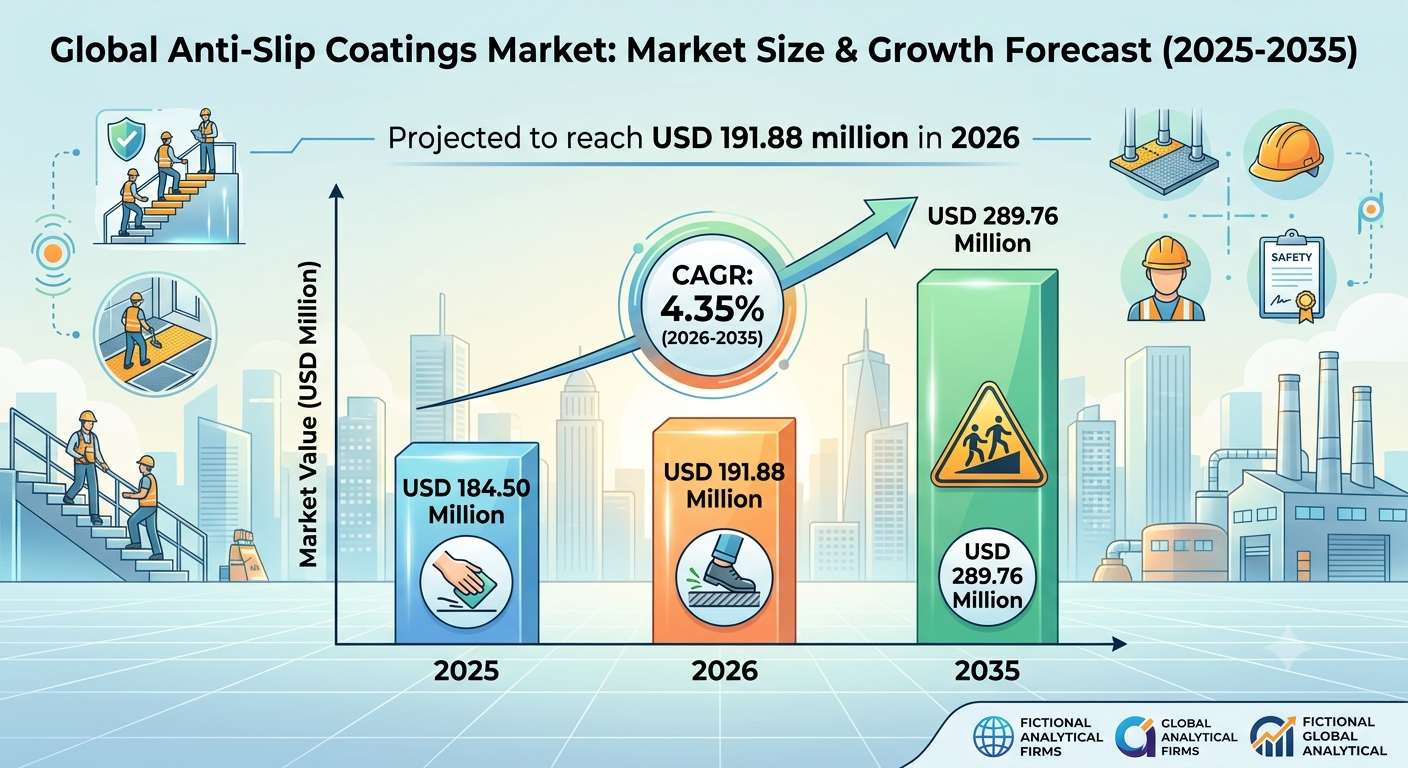
NY, UNITED STATES, August 27, 2026 /EINPresswire.com/ — The Anti-Slip Coatings Market is gaining importance as industries, commercial facilities, healthcare institutions, warehouses, and public infrastructure operators place greater emphasis on workplace safety and slip-and-fall prevention. Anti-slip coatings provide textured, high-traction surfaces designed to improve walking safety while protecting underlying floors from abrasion, chemicals, moisture, and heavy traffic. According to Market Research Future, the global market was valued at USD 184.50 million in 2025 and is projected to reach USD 191.88 million in 2026 and USD 289.76 million by 2035, expanding at a 4.35% CAGR from 2026 to 2035.
Workplace Safety Regulations Strengthen Market Demand
Increasing workplace safety requirements are among the most important factors supporting the growth of the Anti-Slip Coatings Market. Industrial facilities, warehouses, commercial buildings, healthcare centers, and manufacturing plants are increasingly required to maintain safe walking-working surfaces.
Slip-and-fall accidents can result in employee injuries, productivity losses, insurance claims, legal liabilities, and operational disruptions. As a result, facility owners are increasingly treating floor safety as a strategic investment rather than a maintenance expense.
Anti-slip coatings can create textured surfaces with improved traction while maintaining the underlying floor’s durability. Their use is particularly important in areas exposed to water, oil, chemicals, dust, and heavy foot or equipment traffic.
Industrial Applications Lead Market Demand
By application, the market includes Industrial, Commercial, Residential, and Other Applications. The Industrial segment accounted for 44.8% of market revenue in 2025, making it the leading application category.
Manufacturing facilities, warehouses, processing plants, workshops, and logistics centers require flooring capable of handling continuous traffic and demanding operating conditions. Anti-slip coatings can improve traction around machinery, production lines, loading areas, ramps, and walkways.
The expansion of automated manufacturing is further increasing demand. Automated guided vehicles, mobile robots, forklifts, and other equipment require predictable floor surfaces for safe movement, braking, and navigation.
Get Report Sample Copy with TOC: https://www.marketresearchfuture.com/sample_request/7394
Epoxy Coatings Maintain Market Leadership
By resin type, the Anti-Slip Coatings Market is segmented into Epoxy, Polyurethane, Acrylic, and Other Resin Types.
Epoxy captured 46.1% of market share in 2025, making it the dominant resin category. Epoxy systems are widely preferred because of their strong adhesion, hardness, chemical resistance, abrasion resistance, and durability.
Industrial facilities handling chemicals, food products, pharmaceuticals, and heavy machinery often require flooring systems capable of resisting repeated cleaning, mechanical stress, and chemical exposure.
Polyurethane coatings are also gaining traction, particularly in commercial environments where flexibility, UV stability, and aesthetic appearance are important. Retail stores, hospitality facilities, healthcare buildings, and other commercial properties can benefit from polyurethane-based anti-slip systems.
Other resin types are forecast to grow at a 5.12% CAGR through 2035, reflecting increasing demand for specialized coatings in marine, transportation, and extreme operating environments.
Water-Based Technology Gains Ground
By technology, the market is divided into Water-Based and Solvent-Based coatings.
Water-based systems held 62.4% of market revenue in 2025, making them the dominant technology. Their growing popularity is linked to tightening VOC regulations, reduced odor, worker safety, and easier application in occupied facilities.
Healthcare facilities, food-processing plants, schools, commercial buildings, and institutional facilities are increasingly considering water-based coatings because they can provide effective slip resistance while reducing solvent emissions.
Solvent-based systems continue to have applications in demanding industrial environments where high durability and resistance to aggressive operating conditions are priorities. The segment is projected to grow at a 3.48% CAGR through 2035.
Low-VOC Formulations Create New Opportunities
Environmental regulations are encouraging coating manufacturers to develop low-VOC and waterborne formulations. Customers increasingly want products that combine safety performance with lower environmental impact.
Advances in waterborne epoxy, polyurethane, and hybrid coating technologies are helping manufacturers improve abrasion resistance, adhesion, curing speed, and chemical resistance.
Bio-based resin technologies are also gaining attention. Resins derived from plant oils, cashew nut shell liquid, soybean fatty acids, and other renewable sources can potentially reduce reliance on petroleum-based raw materials.
This transition toward sustainable chemistry is creating opportunities for coating manufacturers that can deliver high-performance products without compromising slip resistance.
Buy Now: https://www.marketresearchfuture.com/checkout?currency=one_user-USD&report_id=7394
Healthcare and Pharmaceutical Facilities Drive Specialized Demand
Healthcare and pharmaceutical facilities represent an attractive growth opportunity because these environments require safe, hygienic, and easy-to-maintain flooring.
Hospitals, laboratories, pharmaceutical manufacturing facilities, and clinical environments frequently use cleaning chemicals and require regular washdowns. Flooring systems must therefore combine slip resistance with chemical resistance and low-maintenance characteristics.
Seamless anti-slip coatings can reduce joints and cracks where dirt and contaminants might accumulate. This makes specialized coating systems particularly valuable in controlled environments.
As healthcare infrastructure expands in emerging markets, demand for specialized floor protection and safety coatings is expected to increase.
Food Processing Requires High-Performance Flooring
Food-processing facilities are another important application area. Floors in these facilities can frequently become wet or exposed to oils, fats, food residues, and cleaning agents.
Anti-slip coatings help improve worker safety while providing surfaces that can withstand repeated washing and chemical cleaning.
Epoxy-based systems are particularly relevant because of their chemical resistance and durability. Manufacturers are also developing coatings designed for faster curing, allowing food facilities to minimize production downtime during maintenance.
Automation and Robotics Transform Flooring Requirements
The expansion of factory automation and robotics is creating a new dimension of demand for anti-slip coatings. Automated guided vehicles and mobile robots depend on predictable floor conditions for accurate movement.
Floor surfaces must provide adequate traction while minimizing dust generation and surface deterioration. Poor floor conditions can interfere with automated equipment, increase maintenance requirements, and affect production efficiency.
As manufacturers expand smart factories and automated warehouses, flooring specifications are increasingly being incorporated into facility design at an early stage.
This trend can increase demand for technically advanced anti-slip systems designed specifically for automated industrial environments.
Other Applications Offer Fast Growth
The Other Applications category—including marine, transportation, and sports facilities—is projected to record the fastest growth, with a 5.21% CAGR through 2035.
Marine facilities require slip-resistant surfaces because decks and walkways can be exposed to water, salt, and changing weather conditions. Transportation facilities such as terminals, platforms, ramps, and maintenance areas similarly require durable high-traction surfaces.
Sports facilities can use anti-slip coatings around swimming pools, changing rooms, walkways, and recreational areas where moisture increases slip risks.
The diversity of these applications provides coating manufacturers with opportunities beyond traditional industrial flooring.
Report Summary: https://www.marketresearchfuture.com/reports/anti-slip-coatings-market-7394
Raw Material Price Volatility Remains a Challenge
Despite positive market prospects, raw material price volatility remains a challenge for manufacturers. Epoxy resins, titanium dioxide, pigments, additives, and other chemical inputs can experience price fluctuations due to petrochemical costs, supply disruptions, logistics challenges, and production constraints.
Higher input costs can compress manufacturer margins and increase the price of finished coatings.
Smaller formulators may face greater challenges because they generally have less purchasing power and limited ability to absorb sudden cost increases. Manufacturers are therefore exploring formulation optimization, alternative raw materials, long-term procurement agreements, and greater production efficiency.
Skilled Applicator Shortages Affect Installation
Anti-slip coating performance depends heavily on correct surface preparation and application. Improper preparation, incorrect primer selection, inadequate aggregate distribution, or unsuitable curing conditions can lead to delamination, bubbling, premature wear, and reduced traction performance.
The shortage of skilled applicators can therefore limit market expansion in certain regions. Manufacturers and flooring contractors are increasingly investing in training programs, technical support, application guidelines, and simplified installation systems.
Pre-formulated products and faster-curing technologies can also help reduce application complexity and facility downtime.
Asia-Pacific Leads Regional Growth
Asia-Pacific commanded the largest share of the global Anti-Slip Coatings Market in 2025, accounting for approximately 47.2% of market revenue. The region is also the fastest-growing, with a projected 5.18% CAGR through 2035.
Industrialization, factory modernization, pharmaceutical production, food processing, warehouse construction, and manufacturing automation are major factors supporting regional demand.
China’s manufacturing sector represents a significant source of consumption, while India’s expanding pharmaceutical and food-processing industries are creating additional opportunities.
Southeast Asia is also emerging as an attractive market as electronics manufacturing, industrial parks, logistics facilities, and food-processing operations expand.
North America Benefits from Strong Safety Standards
North America accounted for approximately 24.8% of market share, with the United States contributing around USD 45.76 million in 2025.
Strong workplace safety requirements, commercial construction, healthcare infrastructure, and industrial floor refurbishment support demand across the region.
Facility operators are increasingly investing in preventive safety measures to reduce accident risks and insurance exposure. This creates a relatively stable demand base for high-performance floor coatings.
Europe Focuses on Safety and Sustainability
Europe is another important market, supported by workplace safety initiatives, environmental regulations, industrial modernization, and sustainability targets.
The shift toward water-based and low-VOC formulations is particularly relevant in Europe, where environmental standards influence material selection.
Manufacturers are also exploring bio-based resins and circular chemistry to address growing demand for sustainable construction materials.
Smart Coatings Create Future Opportunities
The integration of digital technologies into building maintenance represents an emerging opportunity. Smart coatings and connected flooring systems could potentially incorporate sensors or monitoring technologies to identify wear, surface deterioration, or changing safety conditions.
Digital wear monitoring could help facility managers shift from reactive maintenance toward predictive maintenance.
Integration with Building Information Modeling systems can also improve product specification, maintenance planning, and asset management across large commercial and industrial facilities.
Competitive Landscape
The global Anti-Slip Coatings Market includes major companies such as Sherwin-Williams, PPG Industries, RPM International, Hempel A/S, Sika AG, BASF SE, Rust-Oleum, Axalta Coating Systems, Jotun, and 3M.
Competition is focused on product durability, traction performance, chemical resistance, VOC compliance, curing speed, application efficiency, and technical support.
Companies are increasingly developing water-based formulations, specialty resin systems, bio-based technologies, and solutions designed for industrial automation.
Technical specification support, maintenance services, and long-term coating contracts are also becoming important competitive strategies.
Related Report
push pull slip sheet market https://www.marketresearchfuture.com/reports/push-pull-slip-sheet-market-37253
US Anti-Slip Coatings market https://www.marketresearchfuture.com/reports/us-anti-slip-coatings-market-20339
Slip Additives Market https://www.marketresearchfuture.com/reports/slip-additives-market-6488
anti slip additive market https://www.marketresearchfuture.com/reports/anti-slip-additive-market-27088
slip sheets market https://www.marketresearchfuture.com/reports/slip-sheets-market-25609
US Slip Additives market https://www.marketresearchfuture.com/reports/us-slip-additives-market-17668
Market Research Future
Market Research Future
+1 855-661-4441
email us here
Legal Disclaimer:
EIN Presswire provides this news content “as is” without warranty of any kind. We do not accept any responsibility or liability
for the accuracy, content, images, videos, licenses, completeness, legality, or reliability of the information contained in this
article. If you have any complaints or copyright issues related to this article, kindly contact the author above.

Media gallery