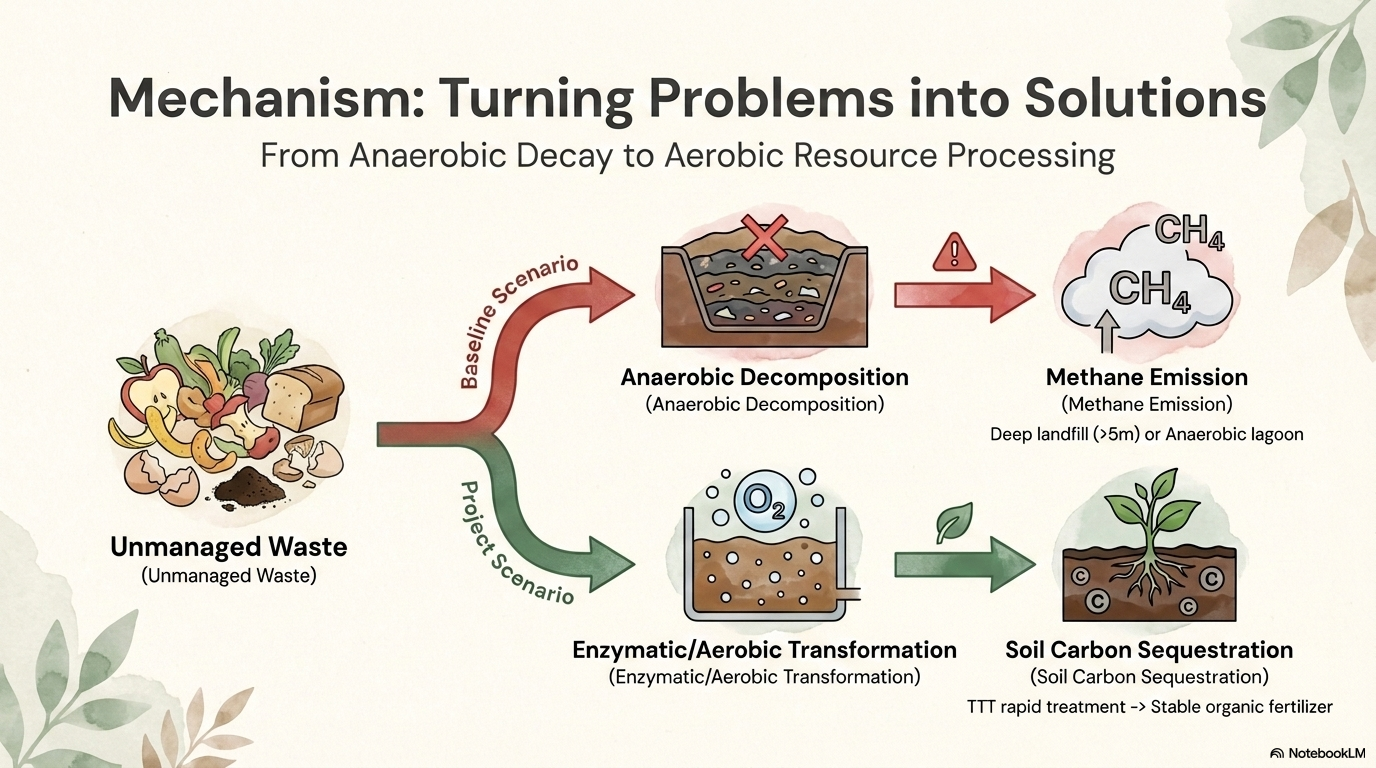
ME0001 establishes a robust framework for methane avoidance, soil carbon enhancement, and the generation of high-integrity carbon credits.
TAIWAN, June 2, 2026 /EINPresswire.com/ — The Satoyama Mace Initiative (SMI) has recently announced on its platform the official release of a revolutionary new methodology as a critical component of its Kunming-Montreal Global Biodiversity Framework (KMGBF)-aligned carbon mitigation series. This groundbreaking framework, titled “ME0001: Avoidance of Methane Emissions from the decay of organic waste through resource processing,” was developed by Academician Prof. Chiu-Chung Young of National Chung Hsing University. By integrating highly efficient technological pathways, this methodology provides a systematic approach to convert organic waste into high-quality organic fertilizers, representing a monumental breakthrough for sustainable agriculture, greenhouse gas (GHG) reduction, and long-term soil carbon sequestration.
The Paradigm Shift in Waste Management: AIMZYME and Technological Innovation
Traditional organic waste management and composting have long been hindered by significant challenges, including extensive time requirements, massive land area demands, and severe environmental issues such as foul odors and wastewater pollution. The newly published ME0001 methodology addresses these bottlenecks by introducing targeted “TTT technology” and an innovative enzymatic solution known as “AIMZYME”.
Backed by a massive functional bacterial stock encompassing over 8,000 strains and 2,500 species, AIMZYME consists of active proteins that function as powerful, specialized catalysts. These enzymes directly and precisely target different organic wastes, accelerating biochemical reactions that facilitate rapid degradation, synthesis, and polymerization. Operating in tandem with dedicated machinery at 80°C, this process not only detoxifies and deodorizes the waste but also effectively exterminates pathogens, insect eggs, and weed seeds. Remarkably, this cost-effective technology breaks the constraints of traditional composting, compressing the maturation process by over a hundredfold. It transforms raw organic waste into stable, ready-to-use organic fertilizer in merely 3 hours, entirely bypassing the need for long-term post-maturation.
Dual-Action Climate Mitigation: Intercepting Methane and Enhancing Soil Carbon Sinks
At the core of the ME0001 methodology is a profound, dual-mechanism approach designed to generate deep and verifiable climate benefits, fundamentally shifting how agricultural emissions are handled.
1. Source-level Methane (CH4) Avoidance: In conventional baseline scenarios, agricultural waste, agro-industrial biomass, and animal manure are frequently relegated to landfills or unmanaged anaerobic disposal systems. The anaerobic decomposition of these materials releases massive quantities of methane, a greenhouse gas with a destructive climate impact far exceeding that of carbon dioxide. By actively diverting these biomass sources into controlled, aerobic enzymatic resource processing systems, the methodology completely disrupts the anaerobic fermentation pathway, achieving a direct climate benefit of “methane avoidance” from the very beginning of the waste cycle.
2. Long-Term Soil Organic Carbon (SOC) Sequestration: The methodology’s climate benefits extend far beyond mere emission avoidance. When the resulting high-quality organic fertilizer is applied to agricultural lands, it drastically improves soil structure, enhances microbial activity, and benefits plant growth while reducing reliance on synthetic chemical fertilizers. More importantly, it facilitates the long-term storage of carbon within the soil, building invaluable “Soil Organic Carbon” (SOC) sinks.
This comprehensive, dual-action approach perfectly fills the critical gap left by existing international methodologies—such as AMS-III.F or VM0042—which previously lacked the framework to account for rapid-cycle enzymatic conversions combined with multi-stage biological treatments.
Rigorous Scientific MRV and Permanence Assurance
To ensure that the carbon credits generated maintain the highest level of international credibility, the Satoyama Mace Initiative has embedded rigorous Measurement, Reporting, and Verification (MRV) protocols. The net greenhouse gas emission reductions are calculated by strictly deducting any project emissions resulting from electricity and fossil fuel consumption during the processing phase, as well as accounting for potential carbon leakage.
Furthermore, to guarantee the permanence of the carbon sinks and comply with high international standards analogous to ISO 14064-2, the project enforces strict ecological safeguards. Project proponents must verify appropriate soil aeration and drainage conditions during fertilizer application to prevent any subsequent anaerobic decay.
To ensure long-term environmental integrity, the methodology mandates regular soil organic carbon (SOC) sampling and monitoring, alongside a mandatory allocation of a portion of the generated carbon credits into a “Buffer pool”. This buffer acts as a vital insurance mechanism to address and mitigate any potential risk of carbon reversal, ensuring the climate benefits remain durable and scientifically verifiable.
Harmonizing with KMGBF Targets and the Satoyama Vision
The launch of ME0001 is not merely a showcase of technological advancement; it is a profound realization of global sustainability goals. It directly embodies the philosophy of the International Partnership for the Satoyama Initiative (IPSI), which prioritizes the revitalization and sustainable management of Socio-Ecological Production Landscapes and Seascapes (SEPLS). By actively engaging local farmers and communities in waste resource recovery, the methodology promotes a true circular economy. It provides rural areas with safe, cost-effective organic alternatives, lowering agricultural pollution and enhancing community resilience and well-being.
Additionally, the framework is intrinsically mapped to the Kunming-Montreal Global Biodiversity Framework (KMGBF). It decisively advances several key targets:
• Target 7 (Reduce Pollution): By curbing the need for chemical inputs and preventing nutrient leaching that harms terrestrial and aquatic biodiversity.
• Target 8 (Climate Mitigation): Through the direct reduction of GHG emissions and the enhancement of nature-based carbon sinks to mitigate climate change impacts.
• Target 10 (Sustainable Agriculture): By improving waste management efficiency and fostering the sustainable use of biodiversity within agricultural ecosystems.
Pioneering a Regenerative and Inclusive Carbon Economy
By blending cutting-edge biotechnology with traditional ecological stewardship, the Satoyama Mace Initiative is setting a new benchmark for global carbon markets. The integration of an advanced System-of-Systems MRV—utilizing satellite remote sensing, AI-driven analytics, and community-based monitoring—drastically reduces transaction costs, empowering Indigenous peoples and local communities to participate equitably in the global carbon economy.
With its high-integrity carbon credits successfully recognized and listed on prominent international trading platforms such as the AirCarbon Exchange (ACX) and Climate Impact X (CIX), the initiative proves that carbon finance can transcend mere offsetting. Instead, it reframes carbon credits as regenerative financial flows that respect Indigenous land rights, restore living ecosystems, and genuinely sustain the planet. This new methodology ensures that every instance of organic waste processing is an actionable step toward a more resilient future, bridging local ecological action with global financial systems for the ultimate benefit of biodiversity and human societies.
Yen-Hsun Su
SEPLS Carbon Credit Regional Revitalization Center
email us here
Legal Disclaimer:
EIN Presswire provides this news content “as is” without warranty of any kind. We do not accept any responsibility or liability
for the accuracy, content, images, videos, licenses, completeness, legality, or reliability of the information contained in this
article. If you have any complaints or copyright issues related to this article, kindly contact the author above.

Media gallery