
Key Takeaways
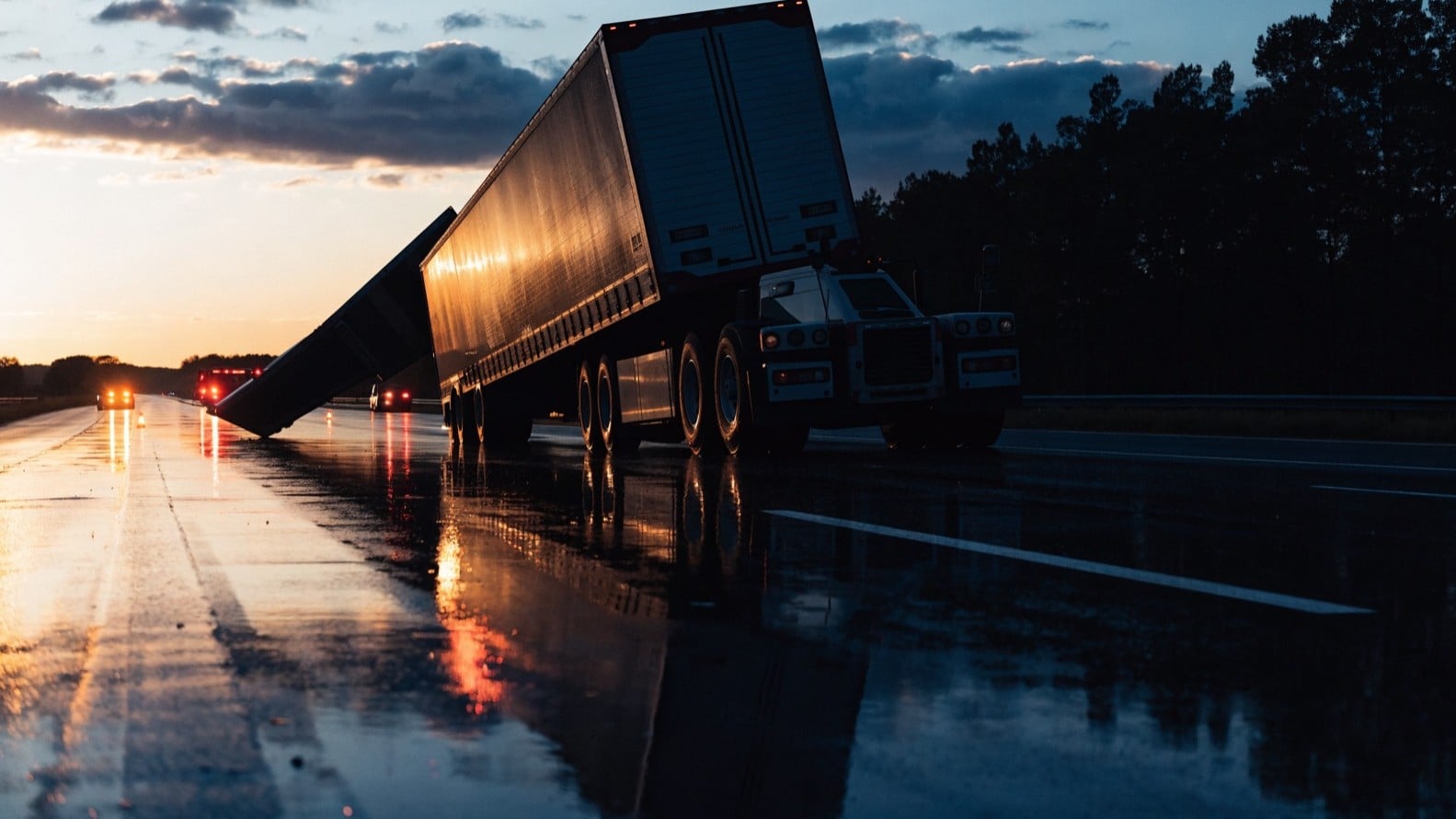
- A jackknife happens when a trailer swings out of line with the cab, often crossing into other lanes as it does.
- Hard braking, a slick road, a trailer riding empty, brakes that were never properly maintained, a driver running on too little sleep, and cargo that shifted mid-drive all show up again and again as causes, and it’s common for more than one to be at play in the same crash.
- Jackknifing is largely preventable, which is part of why insurance companies rarely get to simply call it bad luck.
- Liability can land on the driver, the trucking company, or a separate cargo loader, depending on what actually caused the trailer to swing out.
- Records like ELD data, brake inspection files, and dash-cam footage are usually what settles the question of what really happened.
A jackknife looks dramatic from the outside, the trailer swinging out until the whole rig folds like a knife closing on its handle, but the mechanics behind it are fairly ordinary. Anyone reading the firm’s guide on jackknife accident causes and liability will find that the trailer loses traction or simply outruns the tractor’s ability to control it, and that gap almost never opens up for no reason.
What Actually Happens During a Jackknife
A jackknife doesn’t give much warning. One moment everything looks like an ordinary Tuesday on the highway, and a beat later, the trailer has folded itself across two lanes. Talk to enough truckers about it and they’ll tell you it happens too fast to feel like a decision anyone made. Hard braking is usually where it starts, because a truck’s front tires can grab and slow the vehicle faster than the rear tires ever will, especially with an empty trailer that doesn’t have the weight to keep it planted. Once that gap opens up, the trailer stops tracking behind the cab and starts sliding out to the side instead, and there’s genuinely very little a driver can do once it’s already moving that way. Somebody watching from the next lane over sees a normal truck, then a few seconds later sees the same truck stretched sideways across the road, with nothing in between to make sense of it.
What Tends to Cause One
The single biggest factor is usually how a driver handled the brakes in that moment. Stomping down hard instead of braking smoothly cuts out almost all margin for error, and that margin gets even thinner once the pavement is wet or icy. An empty trailer compounds the problem, since it just doesn’t have enough weight bearing down on the tires to keep them planted.
A driver doesn’t have to do anything wrong for one of these to happen. Sometimes the truck itself was the problem well before it left the yard that morning. Worn brake linings do this. So do brakes that were never readjusted the way they should have been, or a tractor and trailer that simply aren’t braking in step with each other. Put a driver who hasn’t slept enough behind the wheel of a truck with any of those issues, and the odds shift fast, since exhaustion tends to show up as a slow reaction or an overcorrection right when neither one is survivable. Cargo matters here too, in a way that’s easy to overlook. A trailer packed with its weight sitting off to one side carries that imbalance the entire trip, and it often takes surprisingly little to turn a tense moment into one nobody can pull back from.
Why Insurers Rarely Get the Last Word
An insurance adjuster’s first instinct after a jackknife is often to call it bad weather, or bad luck, or just one of those things that happens on the highway. Nobody has to take that explanation at face value anymore. Modern trucks quietly record far too much for a vague story to hold up on its own.
Consider a hypothetical. Imagine a trailer jackknifing on a rainy overpass. The truck’s logging device would show exactly how fast it was traveling and when the brakes engaged, down to the second. If maintenance records showed a brake inspection had been skipped two months earlier, that gap would matter a great deal. And if the truck happened to have a forward-facing camera running, whatever it captured in those final seconds would likely carry more weight than anything either driver remembered afterward.
None of that evidence waits around forever. A carrier isn’t required to hold onto most of it past a certain point, which is exactly why a case built on solid documentation depends on someone requesting it early, before it’s simply gone.
Who Can Be Held Responsible
The Driver
When braking, speed, or attention was the problem, the driver’s own conduct usually becomes the central issue in the case.
The Trucking Company
Texas law generally lets an injured person hold a trucking company responsible for what its driver did, as long as that driver was on the clock and running a dispatched route at the time. Beyond that, a carrier can face its own liability too, separate from anything the driver did behind the wheel, if it skipped required brake maintenance or put an unqualified driver on the road in the first place. Anyone researching truck accident representation will find that most interstate carriers are required to carry at least $750,000 in liability coverage, which is frequently the largest source of recovery available after a serious crash.
The Cargo Loader
Sometimes the real problem started before the truck ever left the lot. If a shifting or poorly secured load helped trigger the jackknife, whoever packed that trailer, which isn’t always the trucking company itself, can end up sharing responsibility for the crash.
Because Texas reduces an injured person’s compensation by their own share of fault and eliminates it entirely once they’re found more than half responsible, getting a clear, early answer about what actually caused a jackknife matters well beyond just satisfying curiosity.
What to Do If This Happened to You
The immediate steps after a jackknife crash look a lot like the steps after any serious truck accident. Get medical attention. Document the scene if it’s safe to do so. Avoid giving a recorded statement to the trucking company’s insurer before talking to an attorney. Because ELD data and dash-cam footage can be overwritten or deleted, getting a preservation request out early can be the difference between evidence that survives and evidence that quietly disappears. More on the firm’s approach to these cases is available on its About page.
The León Law Firm, P.C.
1 Sugar Creek Center Boulevard
Sugar Land
TX
77478
United States


