
Key Takeaways
- The six best financial advisor Facebook ad formats for 2026 are lead generation ads, interactive quiz ads, social proof video ads, educational brand awareness ads, webinar invitation ads, and retargeting ads
- High-converting ad copy leads with a specific client pain point, uses income and life-event targeting, and A/B tests headlines
- Trust is the biggest barrier in financial services advertising, which is why testimonial videos and educational content typically beat generic imagery
- Every campaign needs to comply with FINRA Rule 2210 and SEC advertising rules
6 Ad Formats That Win Clients
Financial advisors are not selling a product people buy on impulse. They are asking someone to trust them with a retirement fund, a child’s college savings, or a life’s worth of work, and that kind of decision does not happen after one scroll-stopping ad. It happens over time, through a sequence of touchpoints that build credibility one step at a time.
That is exactly why format choice matters so much on Facebook, the experts at GetHookd explain. The advisors who consistently fill their pipeline instead treat Facebook as a system, matching a specific ad format to where a prospect sits in their decision-making process.
The 6 Best Ad Formats Ranked
Not every ad format deserves equal attention. Some are built to introduce a cold audience to an advisor’s expertise, while others exist purely to close a warm prospect who already knows the name and the offer. Ranking them by effectiveness helps prioritize where to spend time and ad dollars first.
1. Lead Generation Ads
The lead generation ad remains the most practical tool in a financial advisor’s Facebook toolkit. Instead of sending a click to an external landing page, this format uses Facebook’s native lead form, so a prospect fills out their name, email, and phone number without ever leaving the app.
The format only works as effectively as the offer attached to it. A vague “contact us” ask rarely performs, but a specific incentive changes the equation entirely. Strong offers for this format include:
A personalized portfolio review aligned with the prospect’s stated goals
- A tax-efficiency analysis built specifically for high earners
- A free 30-minute planning consultation with a clear agenda
Copy for this format should name a pain point in the first line and make the next step feel effortless, since friction is the main reason lead forms get abandoned halfway through.
2. Interactive Quiz Ads
Quiz ads flip the usual advertising approach. Instead of pushing information at a prospect, they invite that person to learn something about themselves, which naturally lowers resistance. NerdWallet’s approach to this format is a useful reference point: it turns the advisor search process into something that feels more like a personalized tool than a traditional ad.
A quiz titled something like “What’s Your Retirement Readiness Score?” works because it creates self-identification before any sales conversation begins. These quizzes typically live on a third-party tool such as Typeform or Interact, then route completers to a booking page or lead capture form once they finish.
3. Social Proof Video Ads
Trust is the single biggest obstacle between a financial advisor and a new client, and social proof video ads tackle that obstacle head-on. A real client describing a specific outcome carries far more weight than a polished corporate voiceover ever could.
Advisors without existing client testimonials on hand should not skip this format. An advisor speaking directly to the camera, naming a common fear a prospect is likely feeling, and introducing themselves as a real person rather than a logo can achieve much of the same effect. Authenticity matters more here than production value.
4. Educational Brand Awareness Ads
Not every ad needs to ask for a conversion right away. Educational brand awareness ads exist to position an advisor as a knowledgeable, trustworthy voice long before a prospect is ready to commit to anyone. Sharing a quick explanation of Roth conversion strategy, breaking down sequence-of-returns risk, or unpacking what a Fed rate decision means for everyday savers all fall into this category.
This format performs best as part of a sequence rather than as a standalone play. Running educational content to a cold audience first, then retargeting everyone who engaged with a direct offer ad, mirrors how trust naturally builds between two people.
5. Webinar Invitation Ads
Free webinar or workshop ads work because they offer real perceived value at no cost to the prospect. A few details separate a webinar ad that fills seats from one that gets scrolled past:
- Use a clean image of the advisor with the webinar title and date clearly overlaid
- Keep registration to a single step with no unnecessary form fields
- Choose “Save Your Seat” as the call to action instead of a generic “Register Now”
- Retarget non-attendees afterward with a replay offer to extend the value of the original spend
6. Retargeting Ads
Retargeting ads consistently outperform cold audience campaigns for one straightforward reason: the people seeing them already know the advisor exists. They visited a website, watched a video, or engaged with a page, and simply have not taken the next step yet. That familiarity does most of the persuasive work before the ad copy even gets read.
Running this format requires the Meta Pixel installed on the advisor’s website, which then allows custom audiences to be built around specific page visits. That precision means an ad message can match exactly where a prospect sits in their decision-making process, rather than guessing.
Matching Formats to the Buyer’s Decision Process
Sequencing matters as much as format choice. A simple way to think about it: educational brand awareness ads and social proof video ads work best at the top of the funnel, introducing an advisor’s expertise and credibility to people who have never interacted with the brand before. Interactive quiz ads and webinar invitation ads sit in the middle, giving a warming prospect a low-pressure reason to raise their hand. Lead generation ads and retargeting ads belong at the bottom, converting people who already understand the value on offer and just need the right nudge to book a call.
Building campaigns in that order, rather than jumping straight to a hard offer, tends to produce a steadier flow of qualified leads over time.
Tips for High-Converting Ad Copy
Lead With a Client Pain Point
The most common mistake in financial advisor ad copy is starting with the advisor instead of the prospect. Credentials, years of experience, and certifications matter, but only after a prospect believes the advisor understands their specific problem. Naming the pain first turns those credentials into supporting proof rather than noise a reader skips past.
Target by Income and Life Events
Facebook’s targeting options give financial advisors a level of precision that few other advertising channels can match. Beyond basic age and location filters, campaigns can layer in household income thresholds, investment interests, specific job titles, and life event triggers such as recently engaged, new homeowner, or approaching retirement age. That granularity is especially valuable for advisors who specialize in a narrow niche.
Use Clean, Professional Visuals
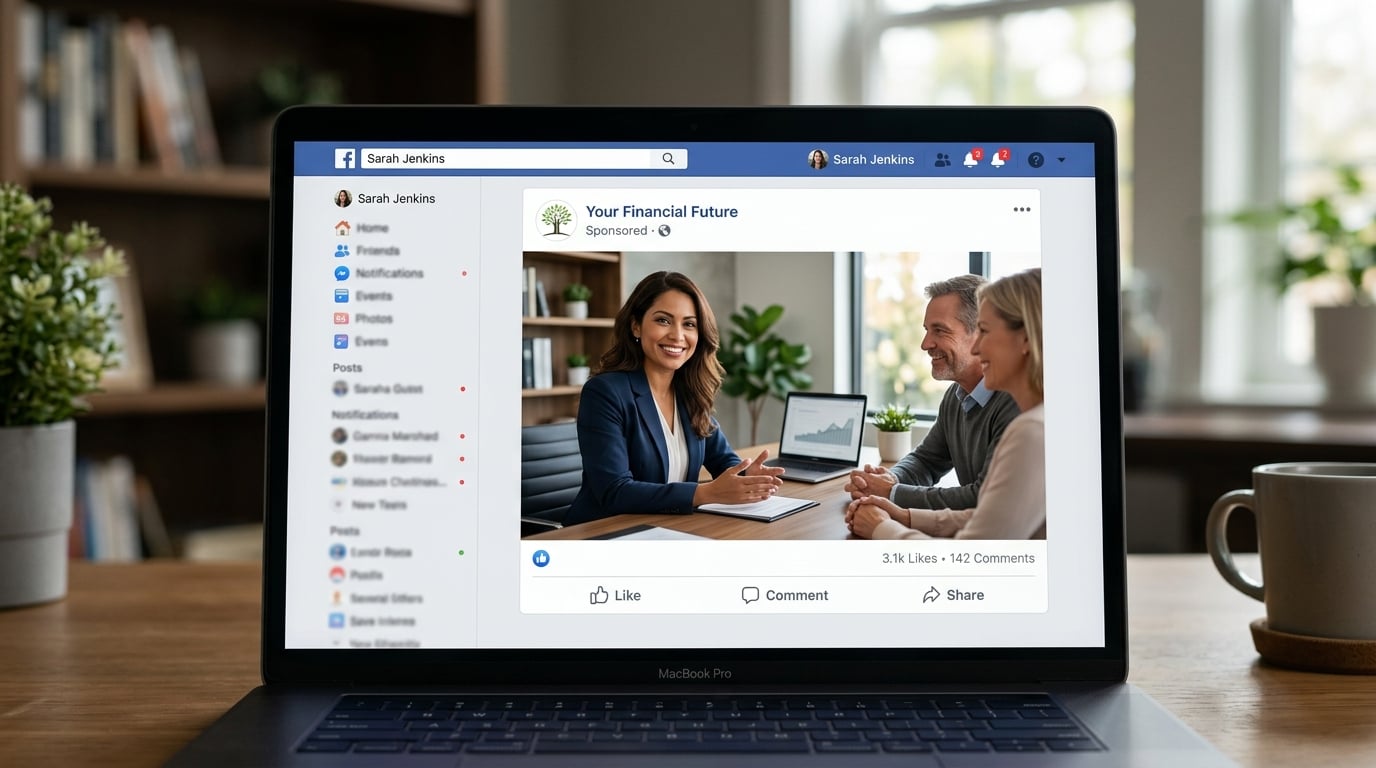
Financial services is a trust-driven category, and visuals communicate credibility before a single word of copy gets read. Clean, professional images featuring real people, ideally the advisor themselves, consistently outperform generic stock photography. A prospect deciding whether to trust someone with their financial future responds better to a real face than a stock image of a handshake.
A/B Test Headlines First
Headlines drive the majority of an ad’s click-through performance, which makes them the single highest-impact element to test. Testing fundamentally different angles, rather than minor word swaps, produces clearer signals.
Staying Compliant With FINRA and SEC Rules
FINRA Rule 2210 and SEC advertising rules apply fully to Facebook ads, and skipping this step is one of the fastest ways to turn a promising campaign into a compliance headache.
The most common issues that trip up financial advisor ads include unsubstantiated performance claims, testimonials that imply future results, and missing required disclosures. A few practical guardrails help avoid those pitfalls:
- Never guarantee investment returns or imply future performance based on past results
- Avoid superlative language like “best” or “top-rated” unless it can be substantiated
- Have a compliance officer review all ad creative, especially anything featuring client testimonials, before a campaign goes live
Building these checks into the creative process saves time and protects the advisor’s license.
Format Choice Determines Trust and Leads
Financial advisor Facebook ads work when they address a specific pain point, speak to a defined life stage, and offer something genuinely useful in return. The six formats covered here, from lead generation ads and interactive quizzes to social proof videos, educational content, webinar invitations, and retargeting, cover the full arc of the buyer’s decision process, from a cold introduction to a booked consultation.
Starting with one format, testing it against a clearly defined audience, and layering in the next stage of the funnel once results stabilize tends to build a far steadier client pipeline than trying to run every format at once.
GetHookd LLC
40 SW 13th street
902
Miami
Florida
33130
United States


